Imagine the startle of finding an email in your inbox with “AI Use Detected: Urgent” in the subject line. Suddenly, your academic integrity is under scrutiny, your confidence shakes, and you grapple with the unsettling fear of being accused of harnessing AI unethically.
We know AI detection tools are on the rise, and sometimes, they may pounce on innocent students with their high-frequency false positives. We’re not here to justify these tools; we’re here to help you navigate their murky waters.
This guide is more than a quick fix. It’s about equipping you – the student; the accused and confused, with a clear strategy and empowerment for fair defense. Let’s address this looming accusation head-on and map out your pathway to resolution.
The First Step: Staying Calm and Gathering Evidence
A jolt of adrenaline rushes through you as you open the damaging email. Fear crawls up your spine, but remember, this is not the end. Here’s your immediate course of action.
First, temper your emotions. You might feel a reflexive need to defend yourself vehemently, but a controlled response is more productive.
Next, seek clarification. If the accusation is vague, ask your teacher to specify which assignment triggered the AI system and why. Request any evidence they have and record it.
Ensure you meticulously document all communication about the accusation. Preserve the date, time, and content of every interaction – emails, meetings, conversations – as they form a crucial part of your defense.
Importantly, resist the urge to purge. Don’t delete drafts, notes, or previous versions of your assignments. These documents can serve as tangible proof of your original work. Lastly, remind yourself that AI detection tools, while advanced, are not infallible. They can misfire, leading to false positives. You have the right to question the validity of the AI report, and confidently so.
This might seem daunting, yet ensuring your academic integrity is vital. These steps will help you establish the groundwork of your defense strategy.
Evidence Collection: Your Key to a Strong Defense
Transform from the accused student into the investigator in the next phase. The aim? To gather irrefutable, concrete proof of your originality. You’ll need to compile a comprehensive body of evidence, showing every facet of the work you’ve done, to refute the AI detection claim convincingly.
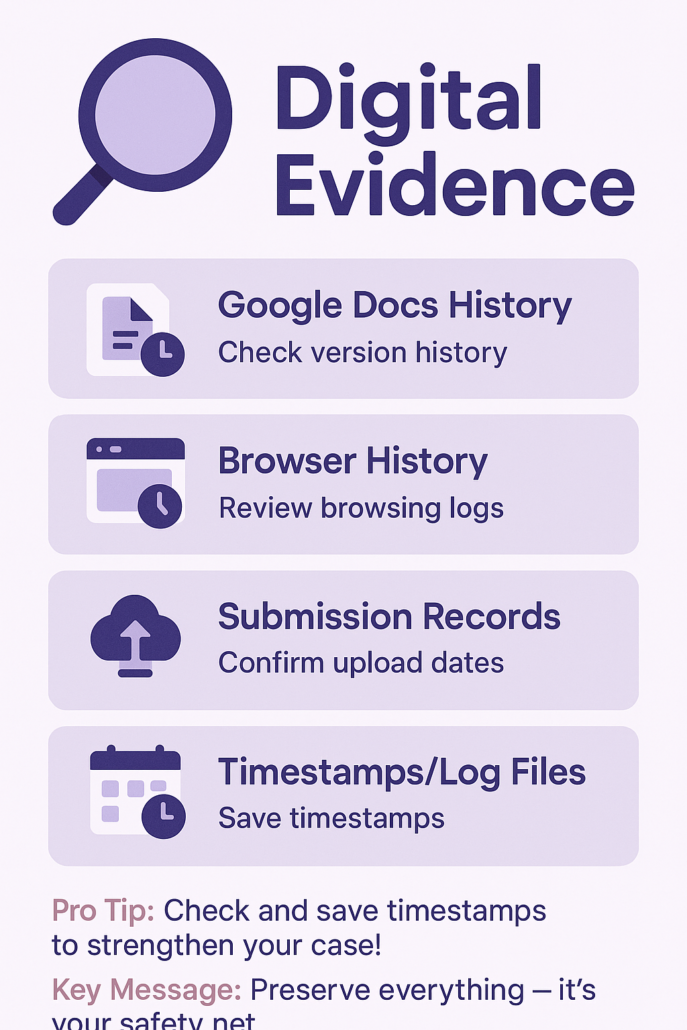
Drafts and outline documents top the list. These show the progression of your thoughts and the development of your assignment over time. Similarly, research notes demonstrate your active engagement in the process of knowledge gathering and assimilation. Your browser history can also indicate diligent research, provided, of course, it leads to credible academic sources.
Next on the list are timestamped document versions, which act like digital breadcrumbs leading back to your original work. This can be the Google Docs history or Word document properties, for instance.
Think also about your thought processes and how you can demonstrate them. Can you describe how you arrived at a particular conclusion or solution? This explanation will provide a wider context and depth to your work, showing your unique perspective.
It might surprise you, but anecdotal evidence of working on the assignment – like a casual conversation with a classmate about the assignment, a question asked to a teacher, or photos of handwritten notes – can all serve as relevant parts of your evidence pool.
Don’t overlook the strength of a powerful narrative shaped by compiling these disparate forms of evidence. Show how your individual intellectual journey culminated in the final assignment, proving it as the fruit of your labor and nothing else.
Digital Trail: Evidence You Can Bank On
Surely, you’ve got a rich digital trail leading back to the inception of your assignment, providing a robust defense against a fallible AI. Let’s carve out an exhaustive checklist to track down every piece of digital evidence at your disposal:
- Scour Google Docs version history: This could unveil progressive draft revisions, showcasing your work’s evolution.
- Review Microsoft Word document properties: Here you might discover creation dates and edit times, solidifying the authenticity of your efforts.
- Capture screenshots of your browser history: This is particularly useful if it contains research that fed into your project.
- Locate any pre-writing notes (be they digital or physical): Did you jot down ideas before you began typing? These can add weight to your claim of originality.
- Seek access to your school’s Learning Management System (LMS) submission history: Here, again, you may find valuable data reinforcing your claims.
Remember, every dot of evidence, regardless of the seeming insignificance, can paint a compelling picture of your academic sincerity in the face of AI accusations.
The Essential Teacher Briefing: Your Steps to Dialogue
Has your evidence pool grown substantially? Outstanding. Now, you’ll use that knowledge base in your impending dialogue with your teacher. Let’s design a roadmap to ensure you navigate this crucial conversation effectively:
1. Take the bull by the horns and schedule a private meeting – the sooner, the better.
2. Preparation is key. Have your evidence at your fingertips, ready to underline your claims in a structured manner.
3. When your teacher airs their concerns, your task is simple: listen, without interruptions or defenses.
4. You’ve heard their side; next is your turn to present your evidence. Be calm, direct, and measured. Logic should drive the conversation, not emotions.
5. Concentrate on your writing process and the originality of your work. No need to discredit their AI tools; focus on warmth, not warfare.
6. Clarity is your best friend here. Ask for a clear understanding of the next steps and the school policy pertaining to your situation.
7. Finally, maintain a respectful tone throughout. Remember: disagreement does not license disrespect.
This conversation is equally about your academic integrity and diplomatic communication – there’s much at stake, so choose your words wisely.
AI Detection Tools: Myths and Truths Unveiled
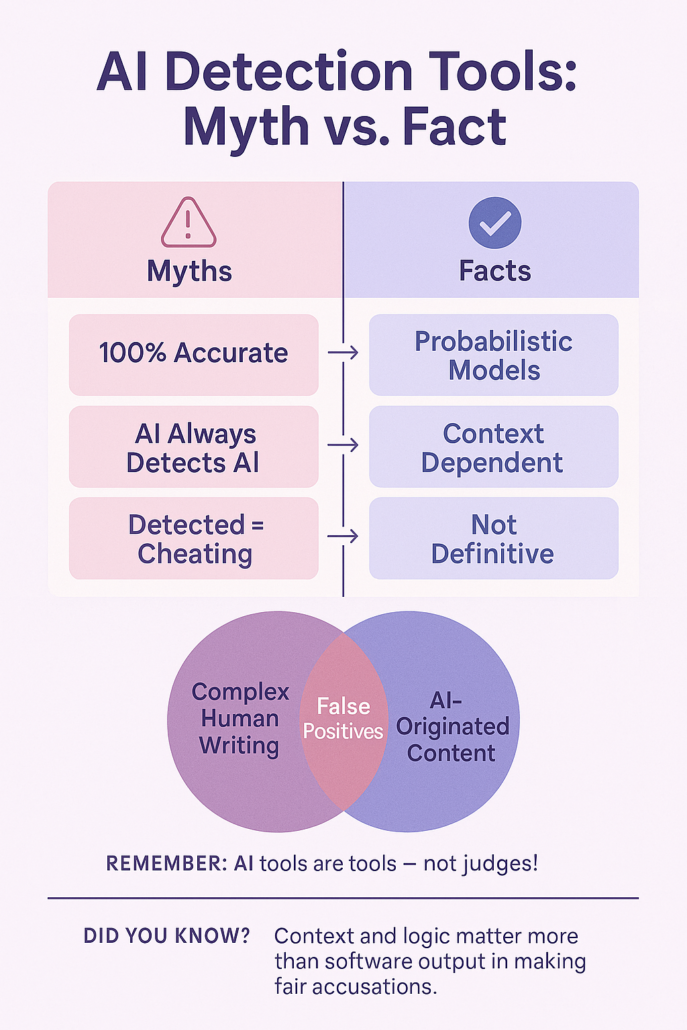
Are AI detection tools infallible arbiters of your academic integrity? Not exactly. Let’s debunk some misconceptions and bring the realities to light:
| Myth | Fact |
| AI detectors are foolproof | They operate on probability, often misinterpreting complex human writing as AI-generated. |
| Perfect literature is a red flag for AI use | Distinct writing styles can result in false positives, even when the work is entirely original. |
| The output of AI tools is definitive proof | These tools serve as initial indicators at best, not unassailable verdicts. |
Dig a bit deeper, and it’s noteworthy that many solutions stem from advanced algorithms. Yet those should not be seen as detrimental to your writing process. On the contrary – students can flip this observation to their advantage. Services like Edubrain can assist students in moulding the most elaborate argument structures.
Architecting outlines for complex essays has also never been easier, enabling you to deliver a wholly rewritten body of work, reflecting true intellectual effort. To the unaided eye, knowing what to do if a teacher accuses you of using AI may seem difficult. Shrouded in technological jargon, the armor of AI detection tools can mislead one into believing in their invincibility.
Unmasking the truth, however, tells a different story. These tools, while certainly helpful guards of academic integrity, shouldn’t be the almighty judge and jury of your scholarly endeavors.
The Leap to Escalation: Evaluating Pros and Cons
Suppose you’ve presented your case, yet the teacher remains unconvinced. The situation then calls for a more formal process: escalating the issue. This decision, however, unfolds like a double-edged sword. We offer a brief analysis of both sides to help guide your steps:
| Pros | Cons |
| Clear pathway to resolution | Potentially lengthy process |
| Formalized procedure | Increased stress levels |
| A chance for vindication | Strained teacher-student relationship |
| Shielding your academic record | Potential disruption to academic progress |
It’s crucial to remember that each situation is unique – weighing these factors is a personalized task. If you feel the benefits outweigh the drawbacks, the quest for justice mustn’t stop with your teacher. Reach out to the department head, academic dean, or a student advocate.
Now, do you feel confident about your school’s academic integrity policy and the appeals process? The power to challenge AI detection claims depends heavily on your understanding of these. Let’s remind ourselves that knowledge is not merely power–in your case, it’s also a lifeline.
Fortification Strategy: Keeping AI Accusations At Bay
Understanding academic integrity doesn’t end once an issue is resolved. Rather, consider it as a learning curve. From an Academic Integrity Specialist, here are some recommendations:
Always keep drafts of your work handy. They serve as concrete evidence of your progress, showing your ideas blossomed over time.
Strive for uniqueness in vocabulary and style. An individualistic writing voice might confuse AI detectors, but it bolsters your claim of originality.
Pay close attention to your citation practices. Sloppy referencing can sometimes resemble plagiarism, and meticulous citation prevents that.
Above all, consistently produce genuine work. Nothing surpasses the value of your original ideas and well-documented studies.
If you wonder about AI tools aiding your brainstorming (provided it’s within the school’s policy), discuss it with your teacher. It sets clear expectations on both ends.
Remember, prevention is the best cure. A well-grounded strategy not only keeps AI accusations at bay but also anchors your academic growth.
Essential Advice: Your Route to a Just Decision
Stay cool-headed. This maxim, though simple, forms your first line of defense against an AI accusation. Calmness enables meaningful evidence gathering – your original drafts, citations, and stylistic choices become tangible reinforcements of your case. Harness respectful communication as a tool; it keeps the dialogue open and productive.
Remember, recognizing your rights as a student provides a protective layer against any hasty conclusions. Lastly, bear in mind the limitations of AI detection tools. At times, they falter, unable to distinguish between AI-generated content and your original work. Treat this as more than just advice—it’s your guide to navigate through the tumultuous waters of an AI accusation. Stand up for yourself, assert your integrity. You might just turn the tide.
After the Storm: Upholding Your Academic Reputation
Standing accused of using AI in academic work can leave a scar, not just on your grades, but also on your academic self-esteem. The emotional impact runs deep – the credibility of your entire work is questioned. A strategic response becomes imperative, not only for the present situation but also for your future standing in academia. Whether it’s gathering evidence or honing communication strategies, every step you take in defense is a lesson learned.
Regardless of how this ordeal ends, you will emerge more enlightened about your rights and the constraints of AI detection tools. Let’s remember that valuing academic integrity isn’t just about avoiding fraud. The real essence lies in learning from each critique and every dispute, and consequently growing into a wiser academician. Remember, when faced with an AI accusation, your reputation isn’t always at stake; perhaps, it’s an opportunity to cement it more firmly.