
Picture yourself in a bustling classroom, juggling lesson planning, grading, and the challenge to offer a personalized learning experience for every student – a familiar scene, isn’t it? Now, imagine if there was a way to ease these pressures and free up more of your time for what truly matters: fostering genuine human connections and inspiring young minds.
Here’s where artificial intelligence enters the scene. No, it’s not here to replace you, far from it. Consider AI your faithful sidekick on this educational journey, equipped to augment your teaching capabilities and leave the routine tasks to its care. The heart of this article? It’s about championing AI as an ally in education, as we navigate the future of teaching together.
AI in Routine Tasks: Your Silent Assistant
Remember the stack of essays waiting to be marked? Or the lengthy emails needing to be sent to parents? Artificial intelligence is here to tackle these burdensome chores. Your silent co-pilot, AI takes control of mundane administrative tasks, freeing you up for what truly makes education meaningful: nurturing young minds and fostering creativity.
Quick exam designing? AI got it. Reading through novels for summary generation? Count on AI for it. Drafting an initial email to a parent? Let AI handle it.
This is the true power of AI – not replacing teachers, but transforming them from administrative operators into focused educators, with more time on their hands to pay attention to their students’ unique needs.
Forget time-consuming busywork, and welcome to the era of productivity. This is where AI becomes less of a distant technological concept and more of an everyday assistant, handling background tasks, so you can focus on being an inspiring guide for your students’ learning journey.
They represent some of the best AI tools for math teachers and general educators, ensuring that time is spent on engagement, not administration.
AI Your Teaching Aid: Diversified Lesson Planning
Do you struggle with satisfying varying learning styles in your class? Is creating interactive quizzes a daunting task? Fret not! AI can lend a hand in multiple facets of lesson planning. Here’s how:
- For students who are visual learners, AI can derive graphical models or concept maps from dense textual content. This brings abstract concepts to life, enhancing comprehension.
- AI helps simplify the creation of interactive quiz questions. It’s adept at converting statements into multiple choice queries or true-false propositions.
- When it comes to brainstorming project ideas, AI proves useful yet again. It’s capable of suggesting a plethora of project themes, based on your lesson plan or subject matter.
- Outlining intricate subjects becomes hassle-free with AI. It’s handy at breaking down complicated themes into simpler, digestible topics.
- Furthermore, integrating the best math photo solvers allows for fast verification of complex problem sets, saving teachers grading time.
Embrace this additional help from AI in lesson planning to keep instruction diversified and engaging for every learner. Its capabilities stretch beyond traditional teaching paradigms, making lessons more bespoke and captivating to meet your students’ unique needs.
AI and the Shift Toward One-on-One Education
Tailored education for each student—sounds like an impossible dream, right? Well, not if AI has any say in it! Artificial intelligence is turning this dream into a reality. Picture this: hundreds of students, each learning at their own pace, through adaptive learning paths nurtured by AI. No student left behind because they couldn’t keep pace with the rest of the class, and no bored students waiting for others to catch up.
AI hones in on individual student performance data, something that even the most dedicated teacher may struggle with. It identifies knowledge gaps and promptly recommends resources to bridge them, thus curbing the risk of letting those gaps widen. By targeting specific weaknesses, these adaptive paths can be compared to using the best brain-training apps, sharpening a student’s core cognitive abilities.
This degree of attention to each student’s learning needs was previously a tall task for one teacher. Now, artificial intelligence is coming to the rescue. As we further integrate AI into our classrooms, personalized learning at a previously unreachable scale is becoming the new normal. Expect students to learn better and quicker, all thanks to this smart co-pilot.
AI doesn’t replace the teacher but amplifies their capacity to attend to each student’s learning journey uniquely.
AI in Practice: Personalizing Education and its Trade-offs
Let’s consider AI’s role in personalizing your students’ education. Is it a magic wand – promising limitless possibilities while challenging data safety and inducing over-reliance?
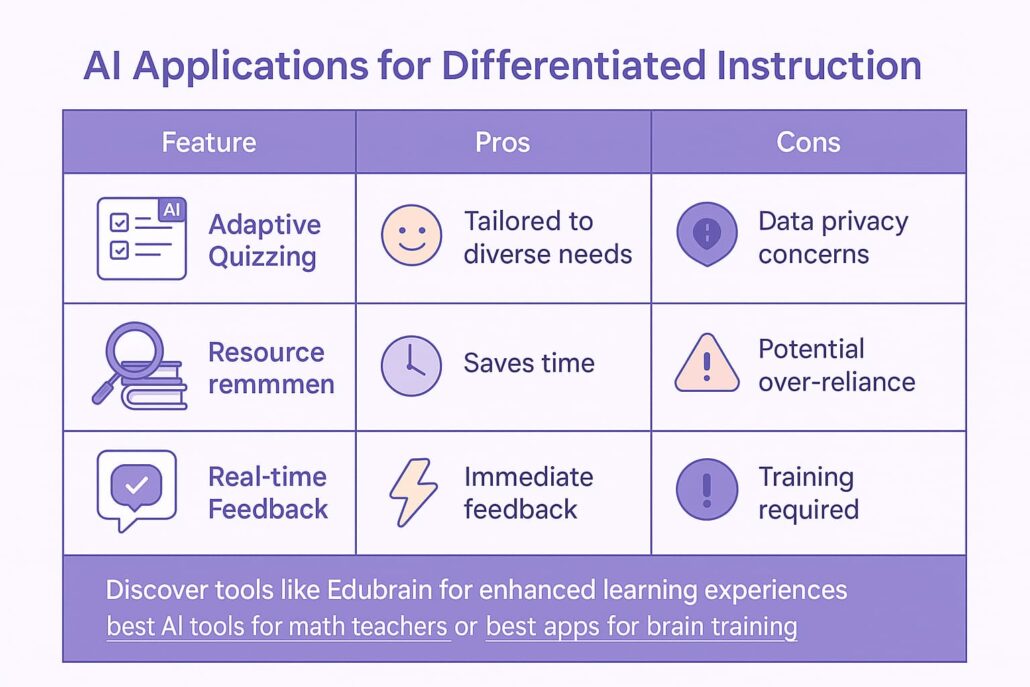
At one end, adaptive quizzing facilitated by AI addresses diverse learning needs at your fingertips. The benefit? Classes become an enriching space for every student – those who excel and those who might need more attention – ensuring no one’s left behind. But the flipside? Are you ready to tackle data privacy concerns associated with this shift?
Resource recommendation by AI certainly saves precious teacher time, but what about the potential hazard of fostering an over-reliance on machine learning? Students might get in the habit of waiting for AI-generated suggestions instead of flexing their brainstorming muscles.
Real-time feedback by AI offers immediate academic tailored responses for students, but the catch? Teachers need extra training to catch up with this new classmate of theirs – AI.
Despite these challenges, some platforms like Edubrain, considered one of the best AI tools for math teachers, balance these pros and cons well. Its ability to help students understand complex concepts is akin to brain-training apps; it’s like tutoring students with the best math photo solvers!
The use of AI in the classroom isn’t perfect, but the vital role it plays is undeniable. It’s about finding the right balance and leveraging these tools to create a dynamic learning environment for students. As educators, understanding the nuances of AI integration can empower you to drive student engagement on a new level.
Unfolding AI in Education: Myths and Realities
AI in the classroom stirs up misconceptions. A storm of questions brews amidst this buzzword, arousing concerns about redundancy, bias, and creativity. Let’s clear these storm clouds by setting facts against myths.
A commonly held belief is that AI will replace educators, yet the reality presents a different story. AI’s central role lies not in replacement but in augmentation—a friendly co-pilot to navigate the choppy waters of modern teaching.
Another myth swirling is AI’s alleged bias. In truth, AI is merely a mirror. It reflects the data it has been fed. Bias can sneak in only if the input data carries such slants. Hence, the key lies not in avoiding AI but in ensuring rigorous and fair data handling when implementing it.
Lastly, naysayers argue AI stifles creativity. But contrary to this belief, AI can boost creativity. By doing the legwork and taking care of routine tasks, AI frees up valuable time for teachers, time that can be channeled toward creative teaching approaches and deeper student engagement.
AI’s entrance into classrooms poses no doubts regarding its potential to fuel the future of education. Yet, coupled with this promise, ethical data use and transparency are of paramount importance as we continue to harness AI’s capabilities. These ethical considerations ensure the swing of AI towards an inclusive, fair, and creative educational sphere.
Navigating AI: A Guided Checklist for Teachers
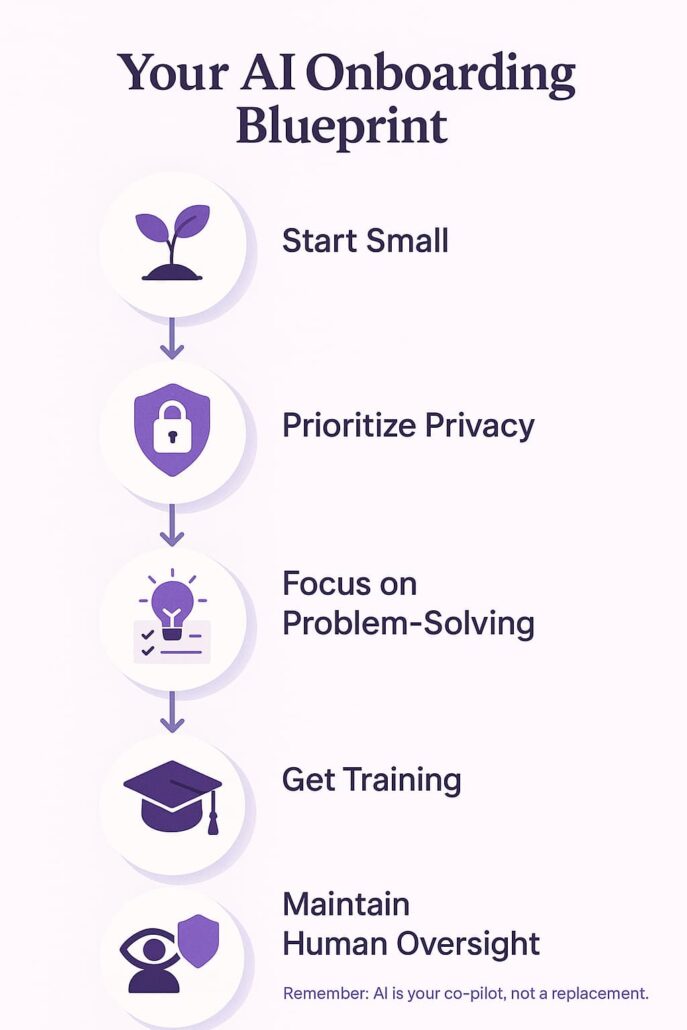
Ready to take off on your AI journey? Make sure you’re equipped with this checklist.
1. Commence Small: Kick-start your journey by piloting one tool. This pace will help you understand how this tech streamlines your work.
2. Privacy on Top: Always remember to take a deep dive into the data policies of your chosen AI tool. This precaution ensures you prioritize students’ privacy.
3. Be Problem-Centric: Choose AI solutions that address your specific challenges in the classroom, rather than getting dazzled by advanced features. A problem-oriented approach can make the most of these new tools.
4. Training is Essential: AI may seem intimidating. But remember — every master was once a beginner. Seek professional development and training in AI, and it will progressively become an ally in your teaching.
5. Keep Hold of the Reins: AI undoubtedly supercharges your teaching capabilities. But remember, you still call the shots. AI merely assists in decision-making and does not replace your judgments.
Your AI exploits are just beginning. Armed with this checklist, unfold the potential of AI in reshaping your classrooms!
AI and Teachers: A Partnership Poised for the Classroom of Tomorrow
Closing the book on this matter, a clear image surfaces: AI becomes an empowering ally for educators rather than being an omnipotent supervisor. The key advantages it brings to the table are significant time-saving capabilities and the ability to personalize learning, not to mention stoutly enhancing student engagement.
Attempting to predict future classrooms, one can envision a symbiotic tailoring of human and artificial intelligence. Teachers, aided by their AI co-pilot, will have the freedom to ignite the emotive spark only human interaction can kindle. It grants educators the liberty to concentrate on the subtle yet potent aspects of education, such as fostering critical thinking, kindling creativity, and strengthening empathy.
That’s a classroom that beckons an optimistic future indeed! This union of traditional pedagogy and technologically accelerated education empowers teachers to craft a more potent, individualized, and fret-free learning environment. That’s a future where AI and teachers are tethered in a profound partnership, guiding students towards a brighter future.